Thursday, 6 March 2014

Wednesday, 5 March 2014
Benedict Cumberbatch or Robert Downey, Jr.?
Benedict Cumberbatch has revealed that some five
years after they first stepped into the character in separate projects,
he and Robert Downey Jr have discussed their respective versions of
Sherlock Holmes. It took two films and three TV series but the pair finally met
recently, with Cumberbatch explaining at the TCA Press Tour: "I sat down
on the sofa with Robert Downey Jr last night, and we had our first
conversation and shared notes on playing Sherlock Holmes."
 The
actors have taken fairly different approaches to the detective role,
with RDJ using brains and brawn in equal amounts and Cumberbatch opting
for a little more reserved, cerebreal Holmes.
The
actors have taken fairly different approaches to the detective role,
with RDJ using brains and brawn in equal amounts and Cumberbatch opting
for a little more reserved, cerebreal Holmes."This is the most dramatised fictional character of all time, so there's a lot to talk about," he added.
Cumberbatch revealed that he also tries to keep up to date with third major league Sherlock Jonny Lee Miller, who plays Holmes in the US series Elementary.
"Jonny is incredibly busy with it. I've seen him on one plane, just by happenstance, since we both started on our separate journeys with it," he said.
"We haven't had a proper sit-down about it, but we adore each other. We're in contact, every now and again, but the last thing we want to do is talk shop. So, I see as much of his as I can, and I think he sees all of our three at a time.
"We're all fans of one another. We're all supportive of it. No matter what bulls**t the press has tried to whip up in the past, we're really good friends. And I can safely say that Robert's in the same camp now, after last night. We had a wonderful chat."
Cumberbatch is set to continue with the BBC adaptation of Sir Arthur Conan Doyle's novels for at least another series, with showrunner Steven Moffat joking about Cumberbatch's schedule and saying that the show will continue until the lead actor becomes "too famous".
Influence of Sherlock Holmes
 |
| Microscope by Seibert from the 19th century |
The Game of Shadows
 Sherlock has been increasingly crazy-seeming since the first film as
he investigates Professor Moriarty and his nefarious scheme (which
Sherlock doesn’t actually know, or even work out. He just keeps
stumbling onto it in action-film style). Also, it happens to be the day before (and day of) Watson’s wedding.
And instead of going on a honeymoon, Sherlock takes him away on a
rollicking adventure to stop Moriarty and help avert a world war. If you didn’t know that Sherlock is supposed to be a detective, you
would think he was a psychic. In the first film they showed him deducing
things by slowing down time in what was essentially Sherlock-vision.
This worked well, because we saw things for an instant as Sherlock sees
them all the time – seeing all the details at every moment.In this film, he doesn’t do the voice-over where he works out the
details. It jumps straight to the part where he fast-forwards through
the fight without explaining how he got there. It gets especially stupid when, during one fast-forward of a fight with Moriarty, Moriarty’s
voice-over interrupts. What? Why is Moriarty interrupting Sherlock’s
prediction? Are they having some sort of psychic battle now?
Sherlock has been increasingly crazy-seeming since the first film as
he investigates Professor Moriarty and his nefarious scheme (which
Sherlock doesn’t actually know, or even work out. He just keeps
stumbling onto it in action-film style). Also, it happens to be the day before (and day of) Watson’s wedding.
And instead of going on a honeymoon, Sherlock takes him away on a
rollicking adventure to stop Moriarty and help avert a world war. If you didn’t know that Sherlock is supposed to be a detective, you
would think he was a psychic. In the first film they showed him deducing
things by slowing down time in what was essentially Sherlock-vision.
This worked well, because we saw things for an instant as Sherlock sees
them all the time – seeing all the details at every moment.In this film, he doesn’t do the voice-over where he works out the
details. It jumps straight to the part where he fast-forwards through
the fight without explaining how he got there. It gets especially stupid when, during one fast-forward of a fight with Moriarty, Moriarty’s
voice-over interrupts. What? Why is Moriarty interrupting Sherlock’s
prediction? Are they having some sort of psychic battle now? Last Fight

Video of the Last Fight
Professor Moriarty
 |
| Illustration of Professor Moriarty by Sidney Paget |
Sherlock Habbits
 |
| Sherlock Holmes pipe and hat |
Holmes had no breakfast for himself, for it was one of his peculiarities that in his more intense moments he would permit himself no food, and I have known him to presume upon his iron strength until he has fainted from pure inanition.
Tuesday, 4 March 2014
Fact about Sherlock

2. The first Sherlock Holmes novel was something of a flop. The detective made his debut in the novel A Study in Scarlet (1887), written by a twenty-seven-year-old Doyle in just three weeks. Famously, Doyle was inspired by a real-life lecturer of his at the University of Edinburgh, Dr Joseph Bell, who could diagnose patients simply by looking at them when they walked into his surgery; the other important influence on the creation of Sherlock Holmes was Edgar Allan Poe’s fictional detective, C. Auguste Dupin (for more on this, see our post on Poe’s contribution to detective fiction here). Doyle wrote the book while he was running a struggling doctor’s surgery down in Portsmouth. The novel was rejected by many publishers and eventually published in Beeton’s Christmas Annual (named after the husband of Mrs Beeton, of the book of cookery and household management). It didn’t sell well, and more or less sank without trace.
The One and Only Woman in Sherlock's life
 Irene Adler is a retired American opera singer and actress. She is one of the most notable female characters in the series, despite appearing in only one story. Five years prior to the events of the plot of the story, while
serving as prima donna in the Imperial Opera of Warsaw, Adler had had a
brief liaison with Wilhelm von Ormstein, the then Crown Prince of Bohemia.
Having recently become engaged to the daughter of the King of
Scandinavia and fearful that, should the strictly principled family of
his fiancée learn of this impropriety, the marriage would be called off,
von Ormstein had sought to regain letters and a photograph of Adler and
himself together. Von Ormstein retains Holmes to help in locating and
obtaining the photograph, but Adler slips away, leaving only a
photograph of herself alone for the King and a note addressed to Holmes
assuring him that the King had nothing to fear from her and that she was
keeping the photograph of them together only as a protection against
any action he might take. The beginning of "A Scandal in Bohemia" describes the high regard in which Holmes held Adler:
Irene Adler is a retired American opera singer and actress. She is one of the most notable female characters in the series, despite appearing in only one story. Five years prior to the events of the plot of the story, while
serving as prima donna in the Imperial Opera of Warsaw, Adler had had a
brief liaison with Wilhelm von Ormstein, the then Crown Prince of Bohemia.
Having recently become engaged to the daughter of the King of
Scandinavia and fearful that, should the strictly principled family of
his fiancée learn of this impropriety, the marriage would be called off,
von Ormstein had sought to regain letters and a photograph of Adler and
himself together. Von Ormstein retains Holmes to help in locating and
obtaining the photograph, but Adler slips away, leaving only a
photograph of herself alone for the King and a note addressed to Holmes
assuring him that the King had nothing to fear from her and that she was
keeping the photograph of them together only as a protection against
any action he might take. The beginning of "A Scandal in Bohemia" describes the high regard in which Holmes held Adler:

To Sherlock Holmes she is always the woman. I have seldom heard him mention her under any other name. In his eyes she eclipses and predominates the whole of her sex. It was not that he felt any emotion akin to love for Irene Adler...yet there was but one woman to him, and that woman was the late Irene Adler, of dubious and questionable memory.
This "memory" is kept alive by a photograph of Irene Adler, which had been left for the King and which Holmes had asked for and received as a reward for his part in the case.
Life with Dr. Watson
Holmes shares the majority of his professional years with his close friend and chronicler, Dr. Watson, who lives with Holmes for some time before his marriage in 1887 and again after his wife's death. Their residence is maintained by the landlady, Mrs. Hudson.
 Watson has two roles in Holmes's life. First, he gives practical
assistance in the conduct of his cases; he is the detective's right-hand
man, acting variously as look-out, decoy, accomplice and messenger.
Second, he is Holmes's chronicler (his "Boswell" as Holmes refers to him). Most of the Holmes stories are frame narratives,
written from Watson's point of view as summaries of the detective's
most interesting cases. Holmes is often described as criticising
Watson's writings as sensational and populist, suggesting that they
neglect to accurately and objectively report the pure, calculating
"science" of his craft.
Watson has two roles in Holmes's life. First, he gives practical
assistance in the conduct of his cases; he is the detective's right-hand
man, acting variously as look-out, decoy, accomplice and messenger.
Second, he is Holmes's chronicler (his "Boswell" as Holmes refers to him). Most of the Holmes stories are frame narratives,
written from Watson's point of view as summaries of the detective's
most interesting cases. Holmes is often described as criticising
Watson's writings as sensational and populist, suggesting that they
neglect to accurately and objectively report the pure, calculating
"science" of his craft.
 Watson has two roles in Holmes's life. First, he gives practical
assistance in the conduct of his cases; he is the detective's right-hand
man, acting variously as look-out, decoy, accomplice and messenger.
Second, he is Holmes's chronicler (his "Boswell" as Holmes refers to him). Most of the Holmes stories are frame narratives,
written from Watson's point of view as summaries of the detective's
most interesting cases. Holmes is often described as criticising
Watson's writings as sensational and populist, suggesting that they
neglect to accurately and objectively report the pure, calculating
"science" of his craft.
Watson has two roles in Holmes's life. First, he gives practical
assistance in the conduct of his cases; he is the detective's right-hand
man, acting variously as look-out, decoy, accomplice and messenger.
Second, he is Holmes's chronicler (his "Boswell" as Holmes refers to him). Most of the Holmes stories are frame narratives,
written from Watson's point of view as summaries of the detective's
most interesting cases. Holmes is often described as criticising
Watson's writings as sensational and populist, suggesting that they
neglect to accurately and objectively report the pure, calculating
"science" of his craft.
Sir Arthur Conan Doyle.
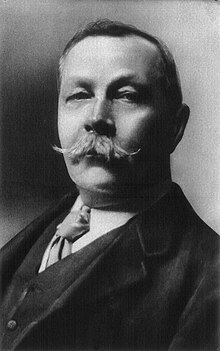 Sir Arthur Ignatius Conan Doyle DL
(22 May 1859 – 7 July 1930) was a Scottish physician and writer who is
most noted for his fictional stories about the detective Sherlock Holmes, which are generally considered milestones in the field of crime fiction. He is also known for writing the fictional adventures of a second character he invented, Professor Challenger, and for popularising the mystery of the Mary Celeste.
He was a prolific writer whose other works include fantasy and science
fiction stories, plays, romances, poetry, non-fiction, and historical
novels. Although Doyle is often referred to as "Conan Doyle", whether this
should be considered a compound surname is uncertain. The entry in which
his baptism is recorded in the register of St Mary's Cathedral, Edinburgh, gives "Arthur Ignatius Conan" as his Christian names, and simply "Doyle" as his surname. It also names Michael Conan as his godfather.The cataloguers of the British Library and the Library of Congress treat "Doyle" alone as his surname. Steven Doyle, editor of the Baker Street Journal,
has written "Conan was Arthur's middle name. Shortly after he graduated
from high school he began using Conan as a sort of surname. But
technically his last name is simply "Doyle". When knighted he was gazetted as Doyle, not under the compound Conan Doyle.
Nevertheless, the actual use of a compound surname is demonstrated by
the fact that Doyle's second wife was known as "Jean Conan Doyle" rather
than "Jean Doyle".
Sir Arthur Ignatius Conan Doyle DL
(22 May 1859 – 7 July 1930) was a Scottish physician and writer who is
most noted for his fictional stories about the detective Sherlock Holmes, which are generally considered milestones in the field of crime fiction. He is also known for writing the fictional adventures of a second character he invented, Professor Challenger, and for popularising the mystery of the Mary Celeste.
He was a prolific writer whose other works include fantasy and science
fiction stories, plays, romances, poetry, non-fiction, and historical
novels. Although Doyle is often referred to as "Conan Doyle", whether this
should be considered a compound surname is uncertain. The entry in which
his baptism is recorded in the register of St Mary's Cathedral, Edinburgh, gives "Arthur Ignatius Conan" as his Christian names, and simply "Doyle" as his surname. It also names Michael Conan as his godfather.The cataloguers of the British Library and the Library of Congress treat "Doyle" alone as his surname. Steven Doyle, editor of the Baker Street Journal,
has written "Conan was Arthur's middle name. Shortly after he graduated
from high school he began using Conan as a sort of surname. But
technically his last name is simply "Doyle". When knighted he was gazetted as Doyle, not under the compound Conan Doyle.
Nevertheless, the actual use of a compound surname is demonstrated by
the fact that Doyle's second wife was known as "Jean Conan Doyle" rather
than "Jean Doyle". 
Subscribe to:
Comments (Atom)
